Blog Post 4
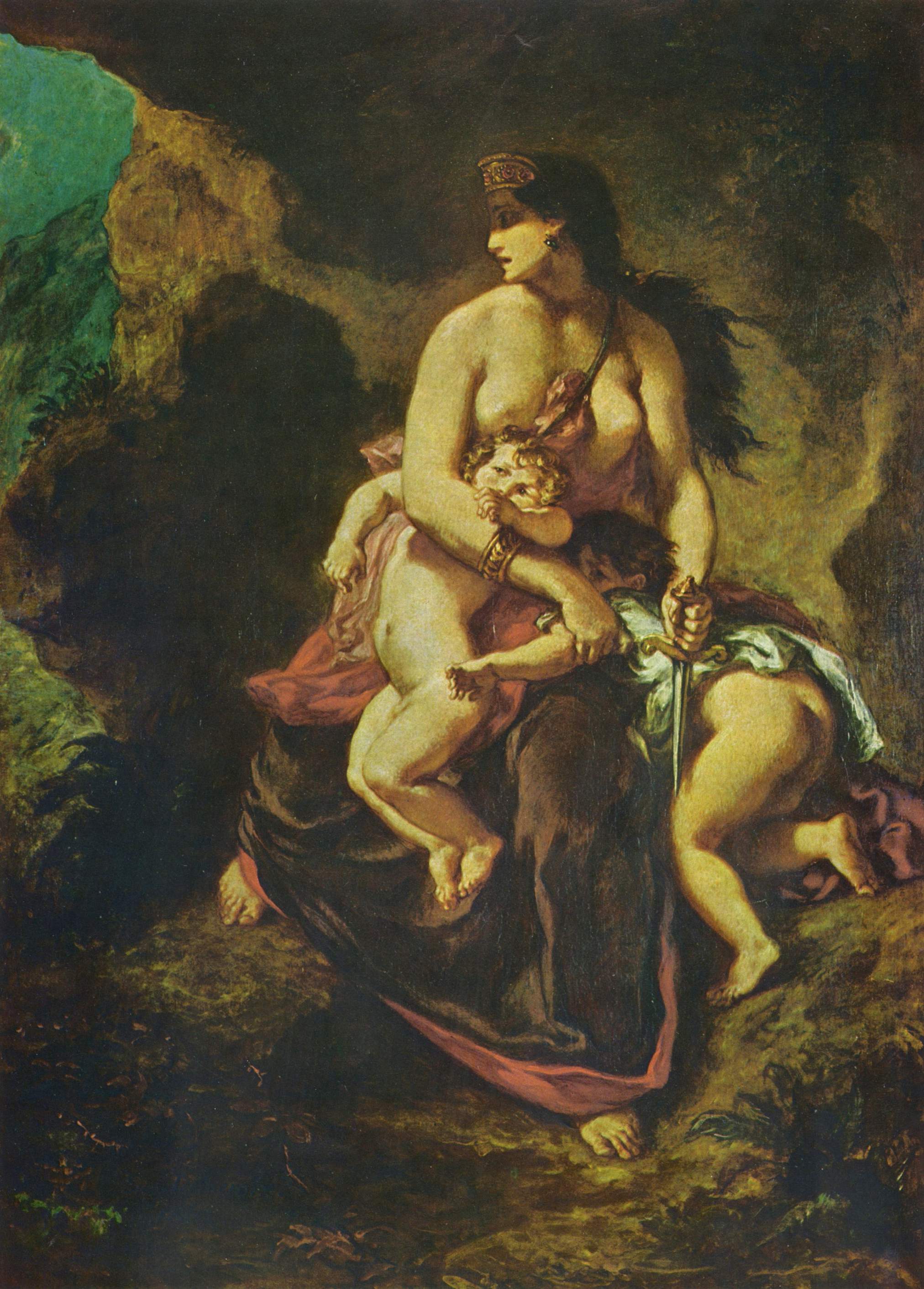
Medea (about to murder her children) by Eugène Ferdinand Victor Delacroix (1862)
https://upload.wikimedia.org/wikipedia/commons/3/38/Eug%C3%A8ne_Ferdinand_Victor_Delacroix_031.jpg
Felicia Dorothea Hemans and William
Wordsworth both explore concepts such as female suffering, unrequited love, and
the power of Nature, in their respective poems, “Indian Woman’s Death Song” and
“The Ruined Cottage.” Although they both seem to come to interestingly similar
conclusions about how death, and in particular one associated with Nature, can
transcend human suffering, they arrive at these conclusions in slightly
different ways. Largely, these differing methods hinge on their female characters’
agency––that is, to what extent are they choosing to meet their ends, and what
the implications of such a choosing might be.
In
Wordsworth’s “The Ruined Cottage,” one of the speakers ultimately arrives at
the comforting conclusion:
That what we feel of sorrow
and despair
From ruin and from change, and all the grief
The passing shows of being leave behind,
Appeared an idle dream that could not live
Where meditation was. (520-4)
From ruin and from change, and all the grief
The passing shows of being leave behind,
Appeared an idle dream that could not live
Where meditation was. (520-4)
This
conclusion indicates that, although Margaret suffered during her life, the
physical evidence of the Natural world engulfing her cottage is indicatory of
the place of Margaret’s suffering in some sort of cosmic scheme. The
introductory passage in our textbook describes this as Wordsworth’s discovery
of “consolation through apprehension of a cosmic unity” (422). Margaret, in her
death, has become part of the Natural world, and her ruined cottage is the
physical manifestation of this.
Hemans’ poem, “Indian Woman’s Death
Song,” addresses the similar theme of some sort of transcendent quality of the
natural world. As the speaker approaches the cataract, which is to be her doom,
she sings of the power of the “dark foaming stream” to take her and her
children to the “better shore” where “the soul shall find its youth” (31, 42).
Although she mourns for her suffering, she willingly, even “triumphantly,”
approaches her Natural doom, because she knows the waterfall can lead her and
her child “to the glorious bowers where none are heard to weep” (11, 40). That
is, in death, specifically a death into
Nature, she can transcend the suffering of her life.
However, the difference, in the end, comes down to the
agency of Margaret and the Indian woman. It is one thing for a character to actively
choose her doom, bringing her child with her in a Medea-like act of rebellion
both against the unrequited love of a male world as well as its suffering, but
it is another thing for two male speakers to passively decide that Margaret’s
suffering, in the end, had its place in the universal flow of things. Margaret’s
voice is only ever heard through paraphrase in “The Ruined Cottage.” Without
knowing her thoughts, it becomes hard to believe the speaker when he attempts
to comfort his friend (as well as the reader). The speaker is still alive, and
in fact never suffered in the way Margaret did, because he was a man who could
move about autonomously, while Margaret had to sorrowfully wait for her husband
to return. Thus, though his vision of Margaret’s death is optimistic, it almost
feels as if it is cheating her of acknowledging any true pain in her lifelong suffering.
Medea (about to murder her children) by Eugène Ferdinand Victor Delacroix (1862)
https://upload.wikimedia.org/wikipedia/commons/3/38/Eug%C3%A8ne_Ferdinand_Victor_Delacroix_031.jpg

No comments:
Post a Comment