Blog Post 3
Gabe Fine
John Clare’s “An Invite to
Eternity” confronts a theme that feels distinct from the other Gothic dangerous
love pieces we read this week. The conflict addressed actually seems to be a
highly epistemological and ontological one. That is, while “The Demon Lover” and
“The Eve of St. Agnes” each seem to function as cautionary tales of a sort, “An
Invite to Eternity” seems rather to be exploring epistemological problems of
the state of our being. Though the poem is framed by the influence of a form of
the death and the maiden trope that Keats and “The Demon Lover” follow, “death”
in this poem seems to rather become allegorical for deep-seated problems in life that Clare realizes.
First of
all, Clare immediately establishes a quality of illusion in his language: the narrator
describes travelling “through the valley depths of shade/ Of night and dark
obscurity” (3-4). Clare threads this notion of darkness as obscurity and/or a
disguising of the true nature of things throughout the poem. Initially, the
narrator seems to associate this darkness with some form of death, linking him
with the tradition of death appealing to a maiden. In the third stanza, the
narrator describes entering some state of non-being (with a nod to Hamlet: “to be, and not to be/ That was,
and is not” (21-2)) in which one can see “Things pass like shadows” above (23).
That is, in death, it appears that knowledge itself seems to fade, or at least
alter. Perception becomes driven by shadows, which are not the thing itself (nuomenon). Though “the
land of shadows wilt thou trace,” for all your efforts to outline just what is
being perceived, people still will not “know each others face[s]” (26). For
Clare, death, more than anything, seems to be characterized by an
epistemological crisis in which things can no longer be fully known, but only
traced.
The second stanza furthers supports
this, by describing how in this place, objects, locations, and concepts
themselves will lose whatever quality links them to reality: “stones will turn
to flooding streams…plains will rise like ocean waves” (9-10). Even life itself
will “fade like visioned dreams” (11). However, this line also points to a
deeper crisis that seems to be immanent in this poem. That is, as death darkens
“mountains into caves,” obscuring things themselves (signifieds) from our conception
of them (signifiers), we may begin to see that there was never any connection between
the two all along. That is, life itself was
a “visioned dream,” and the obscurity of death is not all that different from the
less obvious obscurity of life. Clare draws this connection when he writes,
“this strange death of life to be/ To live in death and be the same/ Without
this life, or home, or name” (19-20). Thus, the true crisis in “An Invite to
Eternity” is not only that death is dark and unknowable, but also that death is
an apocalypse, in its most fundamental sense (an uncovering) of the truth that
the reality of life is just as Plato imagined it to be: shadows of the truth
dancing on the wall. “Past, and present all as one…to join the living with the
dead,” Clare writes, showing us in the end that “We” (death and the maiden, or
death and life) are already “wed to one eternity,” which is and always has been
the same. In life, as in death, all we can do is “trace [our] footsteps,” never
quite knowing where we actually stand.
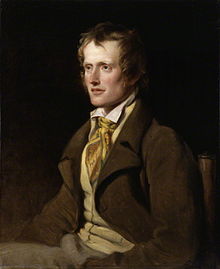
John Clare
https://upload.wikimedia.org/wikipedia/commons/thumb/a/ae/John_Clare.jpg/220px-John_Clare.jpg

Valley of the Shadow of Death by George Inness
http://www.georgeinness.org/The-Valley-of-the-Shadow-of-Death.jpg
John Clare
https://upload.wikimedia.org/wikipedia/commons/thumb/a/ae/John_Clare.jpg/220px-John_Clare.jpg
Valley of the Shadow of Death by George Inness
http://www.georgeinness.org/The-Valley-of-the-Shadow-of-Death.jpg

No comments:
Post a Comment